

Its new guidance on Health Canada clinical trial registration and public disclosure of results, effective July 29, 2026, establishes clear timelines for sponsors: ideally register before enrollment begins in Canada, and no later than 21 calendar days after the first participant is enrolled. Summary results should generally be posted within 12 months after primary study completion.
A clinical trial can be scientifically sound, properly authorized and running exactly according to protocol and still create a transparency gap because somebody forgot to update a public registry.
Health Canada is putting more attention on that gap.
For multinational sponsors, CROs and academic researchers, the message is practical: clinical trial transparency can no longer be treated as an administrative task that sits somewhere between Regulatory Affairs and Publications.
It needs an owner, deadlines, data controls and evidence that the public record remains current.
TL;DR
Health Canada’s July 2026 guidance expects sponsors of covered Canadian clinical trials to:
- Register trials ideally before enrollment opens in Canada, but no later than 21 calendar days after the first participant is enrolled.
- Use an international registry that complies with World Health Organization standards.
- Add Canadian sites to an existing registry record for multinational studies within the applicable timeline.
- Keep registry information current throughout the study.
- Submit summary results to the same registry generally within 12 months of primary study completion.
- Treat primary study completion as the final visit at which primary-outcome data are collected for the last participant in the global study.
There is one regulatory distinction organizations should understand immediately: these are currently Health Canada policy expectations, not legally mandatory registration and reporting requirements. Health Canada describes them as strongly advised and says they are a preparatory step before proposed regulations.
That does not make them something sponsors should ignore. It means organizations should implement them correctly without overstating their current legal status.
What Changed on July 29, 2026?
Health Canada’s guidance became effective July 29, 2026 and applies to sponsors of clinical trials regulated under the Food and Drugs Act and its regulations. Its purpose is straightforward: make information about Canadian clinical trials easier for patients, researchers and the public to find.
The guidance covers three major transparency activities:
registration → maintaining the trial record → public disclosure of summary results
The operational impact is larger than those three words suggest. A registry record can now touch Clinical Operations, Regulatory Affairs, Data Management, Biostatistics, Medical Writing, Publications and study governance. For multinational studies, global and Canadian teams also need to coordinate.
The question is no longer simply, “Did someone register the trial?”
It becomes:
Was it registered on time, are all Canadian sites visible, is the information still accurate, and will results be disclosed by the correct deadline?
Which Clinical Trials Are Covered?
Health Canada says the guidance applies to sponsors of regulated:
- Phase 1 through Phase 3 drug clinical trials;
- Phase 1 through Phase 3 natural health product trials;
- investigational testing involving Class II, III and IV medical devices.
Some studies are outside the scope, including comparative bioavailability studies, single-patient/open-label individual patient trials, certain Phase 4 studies conducted within existing marketing authorization, Class I device studies and licensed devices used within their authorized parameters.
That means sponsors should build an applicability assessment into study startup rather than assume every study follows exactly the same disclosure pathway.

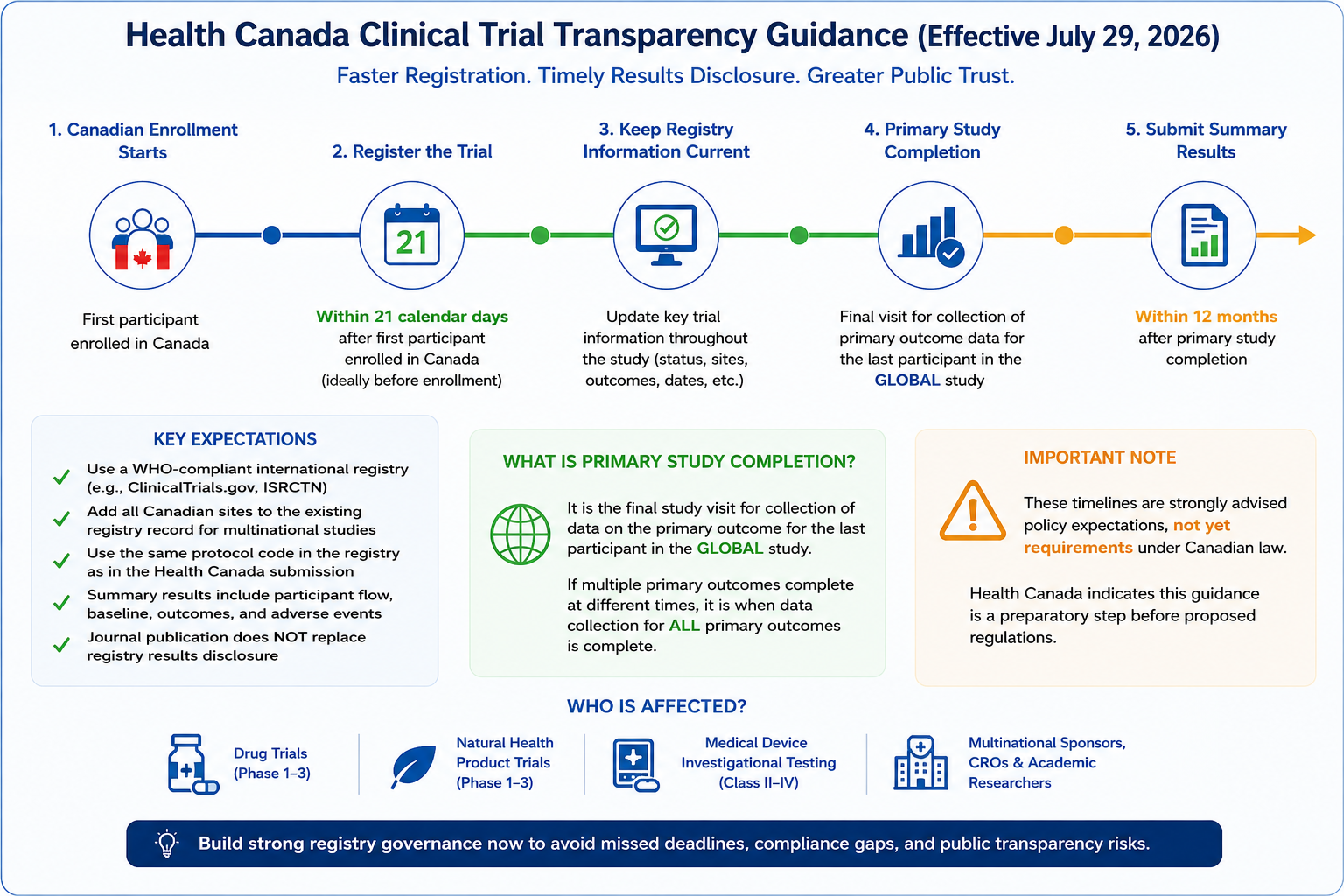
The 21-Day Registration Clock Is the First Control to Fix
Health Canada expects a covered trial to be registered ideally before it opens for enrollment in Canada.
If that does not happen, registration should occur no later than 21 calendar days after enrollment of the first participant.
This creates an obvious operational dependency.
Who knows when the first participant enrolls?
Usually Clinical Operations or the study team.
Who manages the registry?
That may be Regulatory Operations, Clinical Disclosure, Medical Writing or another central function.
If those functions do not communicate, the clock can start without the registry owner knowing.
A better workflow is:
Canadian site activated → enrollment monitored → first participant enrolled → automatic registry deadline triggered → submission confirmed → evidence retained
The deadline should live in the study-management system, not in someone’s inbox.
Multinational Trials Need Special Attention
Health Canada specifically addresses multinational studies with one or more Canadian sites.
Sponsors do not need to create a completely separate Canadian registry record merely because Canada joins an existing global study. Instead, Health Canada expects Canadian sites to be added to the existing registry record. Ideally, that happens before Canadian enrollment begins and no later than 21 calendar days after the first participant is enrolled at the Canadian site or sites.
All Canadian trial sites should be clearly listed.
Imagine a global Phase 3 trial that has been running for six months in the United States and Europe.
Canada joins later.
The study is already registered on ClinicalTrials.gov, so the global team assumes registration is finished.
But the Canadian sites were never added.
The trial exists publicly.
The Canadian participation does not.
That is precisely why Canadian site activation should trigger a registry impact assessment.
Which Registry Should Sponsors Use?
Health Canada does not maintain a separate Canadian clinical trial registry. Instead, sponsors are expected to use an international registry that complies with WHO international standards.
Health Canada identifies ClinicalTrials.gov and ISRCTN as two widely used publicly accessible registries within the WHO ICTRP network that accept Canadian trials across the product categories covered by the guidance.
This is helpful for multinational sponsors because it reduces duplicate registration.
But there is a data-quality catch.
Health Canada recommends including the sponsor’s protocol code in the registry and entering it in exactly the same format used in the clinical trial application submitted to Health Canada.
A missing hyphen sounds trivial.
It can make automated matching harder.
Small master-data inconsistencies can create large transparency problems when regulators increasingly connect information across systems.
Registration Is Not a One-Time Event
One of the biggest process mistakes is treating registry registration as a startup deliverable.
Register it. Check the box. Move on.
Health Canada expects sponsors to keep trial information up to date.
That means registry governance should continue throughout the study.
Changes potentially affecting the public record may include:
- study status;
- recruitment status;
- Canadian sites;
- primary and secondary outcomes;
- completion dates;
- early termination;
- other information required by the selected registry.
For studies that stop early, Health Canada says the registry should be updated with the status, key dates and reason for early termination. This is where version control becomes important.
The organization should be able to answer:
What changed in the trial? Did that change affect the registry? Who reviewed it? When was the registry updated?
The 12-Month Results Clock Is Where Things Become More Interesting
Health Canada expects sponsors to submit summary results generally within 12 months following primary study completion.
The phrase primary study completion matters.
Health Canada defines it as the final study visit for collection of data on the primary outcome for the last participant in the global study.
It is not automatically:
- the last Canadian participant enrolled;
- the last Canadian site visit;
- database lock;
- CSR completion;
- study closeout;
- journal acceptance.
For studies with multiple primary outcomes that complete at different times, primary study completion occurs when data collection has finished for all primary outcome measures.
That date should become a controlled regulatory milestone.
Do Not Let Publication Planning Control Registry Disclosure
This is a common tension.
The manuscript is not ready -> The journal submission is delayed ->The investigators want publication first.
None of those automatically changes the registry timeline.
Health Canada explicitly says journal publication should not replace summary-results reporting in a WHO-acceptable registry.
The two activities should therefore be managed as parallel workstreams:
Clinical results available → registry disclosure
and
Clinical results available → manuscript/publication
Publication strategy should inform disclosure planning, but it should not cause the registry obligation to disappear.
Health Canada does recognize limited situations where disclosure timing can be deferred, including circumstances involving scientific integrity or planned market-authorization applications. Those provisions have specific conditions and timelines and should be assessed deliberately rather than treated as a routine extension mechanism.
What Needs to Be Included in Summary Results?
Health Canada points sponsors toward WHO Trial Registration Data Set expectations.
Summary results can include:
- participant flow;
- baseline characteristics;
- primary and secondary outcome results;
- appropriate statistical analyses;
- adverse events, including serious adverse events and deaths.
These are summary results, not individual patient data.
Sponsors remain responsible for accuracy, completeness and protection against participant re-identification. That means the disclosure process needs controlled reconciliation with validated study outputs. Registry posting should not become an independent manual recreation of the statistical results.
A safer chain is:
validated analysis → approved disclosure dataset → QC → registry submission → confirmation → retained evidence
The Most Important Regulatory Nuance: “Expected” Does Not Yet Mean “Required by Law”
This distinction deserves attention because inaccurate articles may describe the new timelines as mandatory Canadian legal requirements.
Health Canada does not.
The guidance explicitly explains that its policy expectations are recommendations that are strongly advised but not required by law at the time of publication.
Health Canada describes this guidance as a preparatory step before it proposes regulations governing trial registration and summary-results reporting.
That tells sponsors two things.
- First, do not misrepresent the current legal status.
- Second, do not wait for future regulations before building the process.
Organizations that establish governance now will be much better positioned if these expectations later become formal regulatory requirements.
Five Compliance Gaps Sponsors Should Look for Now
1. Nobody clearly owns the registry
Clinical assumes Regulatory owns it. Regulatory assumes Disclosure owns it. Disclosure assumes the CRO handles it. Give every trial a named registry owner.
2. Canadian sites are added late
For multinational trials, build a registry check directly into Canadian site activation.
3. Registry information drifts away from the protocol
Protocol amendments and operational changes should trigger an assessment of whether public registry information needs updating.
4. The wrong date starts the results clock
Define primary study completion according to Health Canada’s global primary-outcome definition and capture it centrally.
5. Publication and disclosure teams work separately
Create one integrated disclosure calendar showing database milestones, primary study completion, registry results deadline, CSR timing and publication plans.
A Practical Sponsor Readiness Checklist
Sponsors can start with seven questions:
- Which active Canadian trials fall within scope?
- Is every covered trial registered in a WHO-compliant registry?
- Are all Canadian sites correctly listed?
- Does the registry protocol code exactly match the Health Canada submission?
- Who owns ongoing registry updates?
- Is primary study completion captured as a controlled milestone?
- Does every completed trial have a visible results-disclosure deadline?
If any answer is unclear, that is the first place to investigate.
Why This Is Bigger Than a Registry Deadline
- Clinical trial transparency is increasingly becoming part of the credibility of clinical research.
- Patients volunteer their time and accept uncertainty to generate evidence.
- Researchers use previous trial results to design future studies.
- Healthcare professionals need access to evidence that does not depend entirely on which studies eventually appear in journals.
- And regulators increasingly want trial information to be accessible, consistent and internationally aligned.
- Health Canada’s guidance therefore signals a broader direction:
The clinical trial record does not end when the database locks. Public disclosure is part of the study lifecycle.
For sponsors, the practical response is not complicated.
- Know which studies are covered.
- Give registry management a clear owner.
- Connect Canadian site activation to registration.
- Keep the public record synchronized with the study.
- Start the 12-month disclosure clock from the correct global milestone.
- And do it now, before strongly advised expectations become harder regulatory obligations later.
Frequently Asked Questions
Which clinical trials are covered by Health Canada’s transparency guidance?
The guidance covers Phase 1–3 drug and natural health product trials and investigational testing involving Class II–IV medical devices regulated under the Food and Drugs Act and applicable regulations.
What is the Health Canada 21-day clinical trial registration rule?
Health Canada expects covered trials to be registered ideally before enrollment opens in Canada, but no later than 21 calendar days after the first participant is enrolled. At present, this is a strongly advised policy expectation rather than a statutory requirement.
What counts as primary study completion?
Health Canada defines primary study completion as the final study visit for collection of data on the primary outcome for the last participant in the global study. If there are multiple primary outcomes with different completion dates, it is when data collection for all primary outcomes is complete.
Do multinational studies need to include Canadian sites in the registry?
Yes. Health Canada expects multinational studies with Canadian sites to add those sites to the existing registry record, ideally before enrollment begins in Canada and no later than 21 calendar days after the first participant is enrolled at the Canadian site or sites.
Can sponsors delay results disclosure until a journal article is published?
Journal publication does not replace registry results disclosure. Health Canada provides limited circumstances for deferral, including certain market-authorization situations, but sponsors should not assume publication planning automatically postpones the registry timeline.