FDA released a cluster of drug-development guidances in August 2026 that regulatory and CMC teams should not treat as routine document updates.
The subjects reach into some of the decisions made very early in product development: Which application pathway should we use? How will FDA evaluate therapeutic equivalence? Is the container closure system adequately supported? What evidence will FDA expect for transdermal products or biosimilars?
One guidance is final. Several others remain draft. That distinction matters. But so does the direction FDA is signaling. For sponsors with products already in development, this is a good time to ask a simple question:
Was our development strategy built around assumptions FDA has now clarified or changed?
TL;DR
FDA’s August 2026 guidance activity includes several documents with direct implications for generic, biologic, biosimilar and CMC programs.
Among the important developments:
- Evaluation of Therapeutic Equivalence — Final guidance, issued August 24.
- Determining Whether to Submit an ANDA or a 505(b)(2) Application — Draft guidance, issued August 18.
- Container Closure Systems for Human Drugs and Biological Products — Draft guidance, issued August 14.
- FDA also issued August guidance affecting transdermal and topical delivery systems and published additional biologics-related guidance activity.
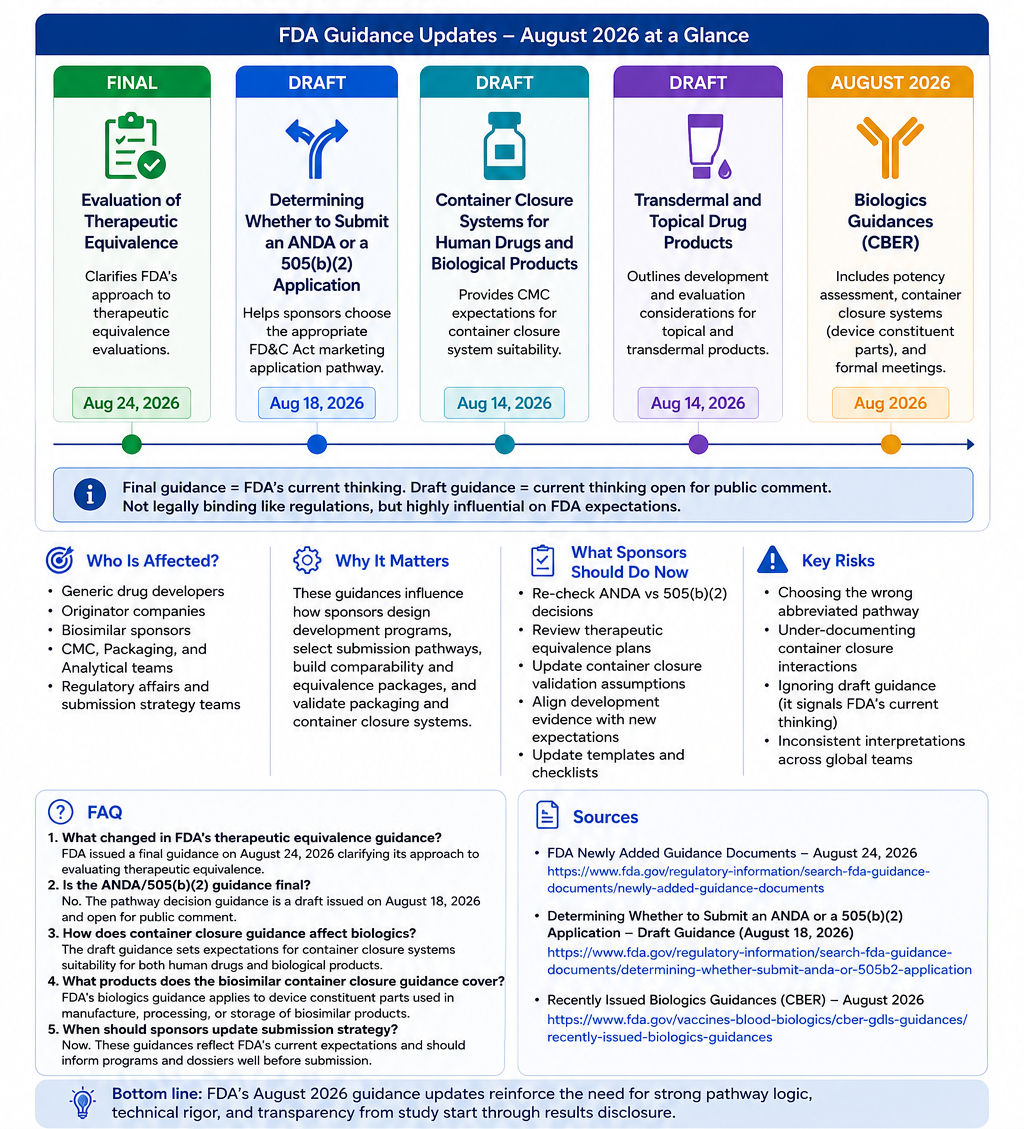
The immediate lesson is not that FDA has created a new regulation.
These are guidance documents. But they can materially affect how sponsors design development programs, select application pathways, build evidence packages and justify CMC decisions.
Teams with active or upcoming U.S. submissions should perform a targeted gap assessment rather than waiting until dossier preparation begins.
1. FDA Finalized Its Therapeutic Equivalence Guidance
- FDA’s Evaluation of Therapeutic Equivalence guidance became final in August 2026.
- Therapeutic equivalence is especially important in the generic-drug market because FDA’s evaluations and therapeutic equivalence codes appear in the Orange Book.
- FDA explains that products classified as therapeutically equivalent can be expected to have the same clinical effect and safety profile when administered under the conditions specified in the labeling.
- The final guidance explains FDA’s thinking on therapeutic equivalence evaluations and TE codes and replaces the draft issued in July 2022.
Why should generic teams care?
- A generic-drug strategy does not end when bioequivalence is demonstrated.
- Teams need to understand how FDA evaluates the relationship between approved multisource products and how those evaluations may ultimately be reflected in the Orange Book.
- For companies developing or commercializing generics, the final guidance is therefore worth incorporating into:
- regulatory strategy;
- therapeutic-equivalence assessments;
- Orange Book reviews;
- product-launch planning;
- internal training.
Because this guidance is final, organizations should review procedures and assumptions against FDA’s current published position rather than continue relying on the 2022 draft.
2. FDA Is Reopening the ANDA vs. 505(b)(2) Decision
One of the most important August updates is FDA’s revised draft guidance:
Determining Whether to Submit an ANDA or a 505(b)(2) Application.
This is currently draft guidance. It is not final and is being distributed for comment.
FDA describes it as foundational guidance intended to help applicants determine which abbreviated approval pathway under the Federal Food, Drug, and Cosmetic Act is appropriate.
The question sounds simple:
ANDA or 505(b)(2)?
In practice, getting it wrong can affect the entire development program.
An ANDA generally relies on demonstrating that the proposed generic meets the requirements applicable to the reference listed drug.
A 505(b)(2) application can rely partly on information that the applicant does not own or for which it does not have a right of reference, while also providing additional evidence necessary to support differences from the relied-upon product.
The revised draft identifies criteria and considerations for determining which pathway may be appropriate.
Why this deserves attention now
Pathway selection influences:
- clinical-development requirements;
- bioequivalence strategy;
- formulation development;
- labeling;
- bridging evidence;
- submission structure;
- development cost;
- regulatory timeline.
A company should not discover during pre-submission review that its product does not fit comfortably within the pathway selected years earlier.
For programs approaching submission, Regulatory Affairs should revisit the original pathway rationale against the 2026 draft.
FDA is accepting comments on this draft through October 19, 2026.
3. Container Closure Systems Are Getting Fresh FDA Attention
FDA also issued draft guidance on Container Closure Systems for Human Drugs and Biological Products.
The document provides principles for evaluating the quality of container closure systems used for human drugs and biological products.
Importantly, its scope also reaches container closure systems that function as device constituent parts of combination products.
Packaging is sometimes treated as something that happens after the drug formulation is essentially finished.
That can be a costly mistake.
The container closure system can affect:
- product protection;
- stability;
- compatibility;
- extractables and leachables;
- integrity;
- delivery performance;
- product quality over shelf life.
A technically acceptable formulation does not automatically mean the finished packaged product is adequately supported.
What CMC teams should do
Programs should review whether existing evidence adequately connects:
product → container materials → compatibility → integrity → stability → manufacturing → storage → intended use
This is particularly important for biologics and combination products, where interactions between product, container and delivery components can become more complex.
The guidance remains draft and FDA is accepting comments through October 13, 2026.
That means companies should not describe every recommendation as a new binding requirement.
But draft guidance still provides valuable insight into FDA’s current thinking and where future review questions may arise.
4. Transdermal and Topical ANDA Development Is Also Being Refined
FDA’s August guidance activity also includes transdermal and topical delivery systems.
FDA finalized guidance on evaluating adhesion for transdermal and topical delivery systems submitted in support of ANDAs and issued revised draft recommendations addressing skin irritation and sensitization.
These are not minor performance characteristics.
Consider a generic patch.
Even if the active ingredient and pharmacokinetic performance are acceptable, a product that repeatedly lifts from the skin or causes materially different irritation can create practical concerns.
For developers, FDA’s latest guidance provides a reason to reassess study design before generating expensive evidence.
The useful question is:
If our adhesion, irritation or sensitization study started today, would we design it the same way after reading FDA’s 2026 guidance?
If the answer is no, the development plan deserves another look.
5. Biosimilar Packaging and Delivery Systems Are Part of the Same Story
FDA has also published draft guidance addressing container closure systems and device constituent parts for biosimilar and interchangeable biosimilar products.
This matters because a biosimilar is not developed in isolation from how patients receive it.
Differences involving syringes, autoinjectors or other delivery configurations may raise development questions even when the biological product itself is highly similar to the reference product.
FDA says the draft is intended to clarify recommendations concerning development of delivery devices and container closure systems for proposed biosimilar and interchangeable biosimilar products.
For biosimilar developers, this reinforces an important principle:
Device and packaging strategy should begin early enough to influence development—not after the analytical comparability program is nearly complete.
Draft Does Not Mean Irrelevant—and It Does Not Mean Final
Regulatory teams need to avoid both extremes.
The first mistake is saying:
“It’s only draft guidance, so we can ignore it.”
The second is saying:
“FDA published it, so every recommendation is now mandatory.”
Neither is accurate.
FDA’s draft ANDA/505(b)(2) and container-closure guidances explicitly state that they are not for implementation and contain non-binding recommendations.
Draft guidance nevertheless tells industry where FDA’s current thinking is heading.
A sensible approach is:
Final guidance → assess implementation against current procedures.
Draft guidance → assess development risk, identify potential gaps, consider commenting, and monitor for finalization.
What Sponsors Should Do Now
Companies do not need to rebuild every development program because FDA published new guidance.
They should perform a focused gap assessment.
Start with five questions:
- Application pathway: Would we still choose ANDA or 505(b)(2) using FDA’s latest thinking?
- Therapeutic equivalence: Do internal assessments reflect the new final guidance?
- Container closure: Is our evidence adequate for the product, packaging and intended use?
- Special product considerations: Are transdermal, topical or biosimilar programs aligned with the latest recommendations?
- Submission timing: Is an upcoming dossier based on an older FDA assumption that should be revisited before filing?
Document the assessment.
If no change is necessary, record why.
If a gap exists, decide whether it affects the development plan, submission content, testing or FDA interaction strategy.
That creates evidence that the organization did more than simply circulate a new guidance by email.
The Bigger Message From FDA’s August Guidance Activity
These documents cover different subjects, but together they tell a consistent story.
FDA is sharpening expectations around the decisions that connect:
regulatory pathway → development evidence → equivalence → product quality → packaging → delivery → submission
Those decisions should not exist in separate departmental silos.
Regulatory Affairs may own pathway strategy.
CMC may own container closure.
Clinical or biostatistics teams may support comparative evidence.
Device engineers may own delivery-system development.
But FDA ultimately reviews one product and one application.
The strongest development programs make those pieces tell the same story.
Frequently Asked Questions
What changed in FDA’s therapeutic equivalence guidance?
FDA finalized guidance explaining its approach to therapeutic equivalence evaluations and TE codes used in the Orange Book.
Is FDA’s 2026 ANDA vs. 505(b)(2) guidance final?
No. The August 2026 document is draft guidance and is open for comments through October 19, 2026.
Is the new FDA container closure guidance final?
No. It is draft guidance covering container closure systems for human drugs and biological products, including certain combination-product applications.
Should companies follow draft FDA guidance?
Draft guidance is not final and contains non-binding recommendations. However, sponsors should evaluate it because it communicates FDA’s current thinking and may identify issues relevant to active development programs.
When should sponsors review their submission strategy?
Now is a sensible time for programs approaching pivotal development, FDA meetings or submission to gap-check their existing assumptions against the latest guidance.